Feedback
Mae carves – but with two flexed legs!
Ella has switched from zero carving to doing it well.
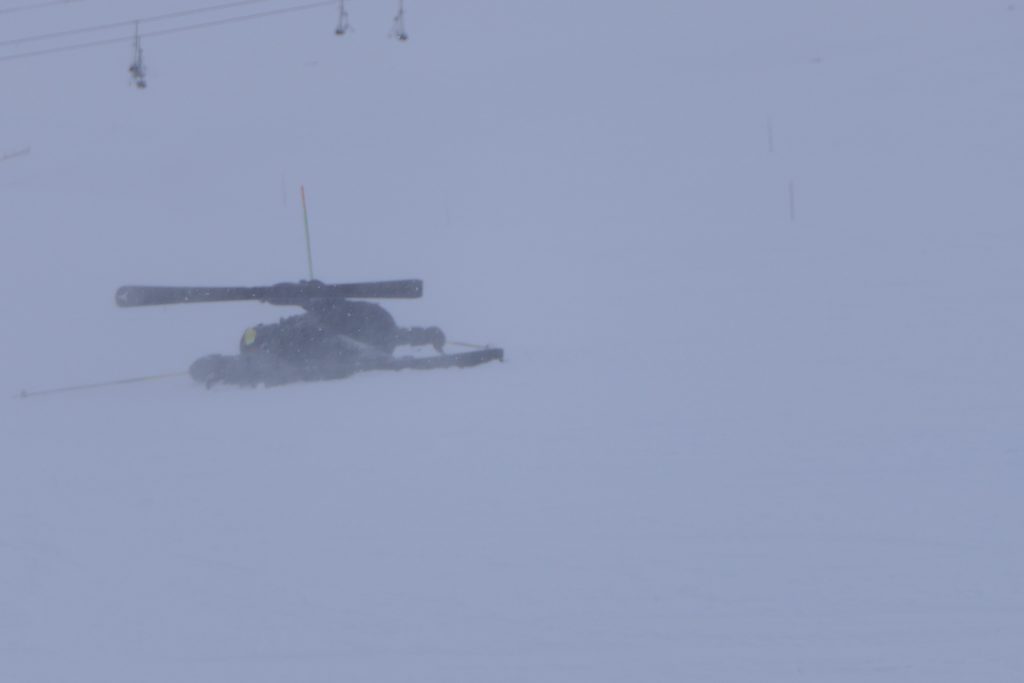
Anthony’s fall is probably caused due to there being almost no hip angulation. Add that to lack of experience carving. Clearly extending the outside leg correctly – now it just needs to add flexion at the hip.
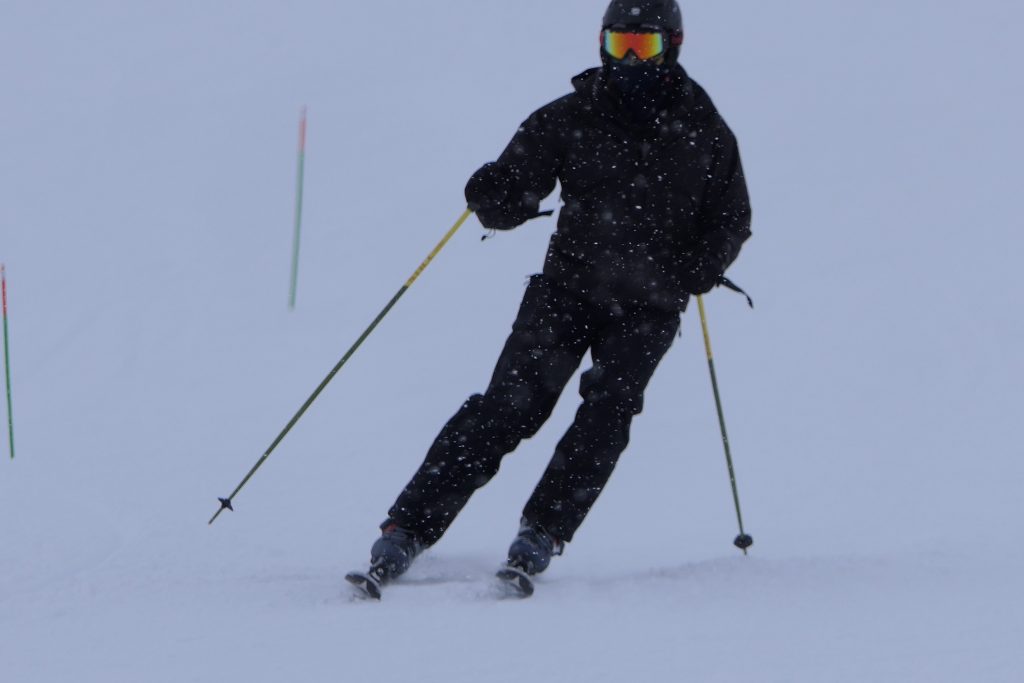
Mae does some pretty good “compression turns” (training for moguls and leg retraction in carving).
Ella also does some good ones.
Anthony thinks he is extending his legs to complete the turn – but he isn’t!
Today’s focus – following yesterday’s introduction on Dynamics, Skating and Pivoting
- Adductor Muscles – One Legged Pivot
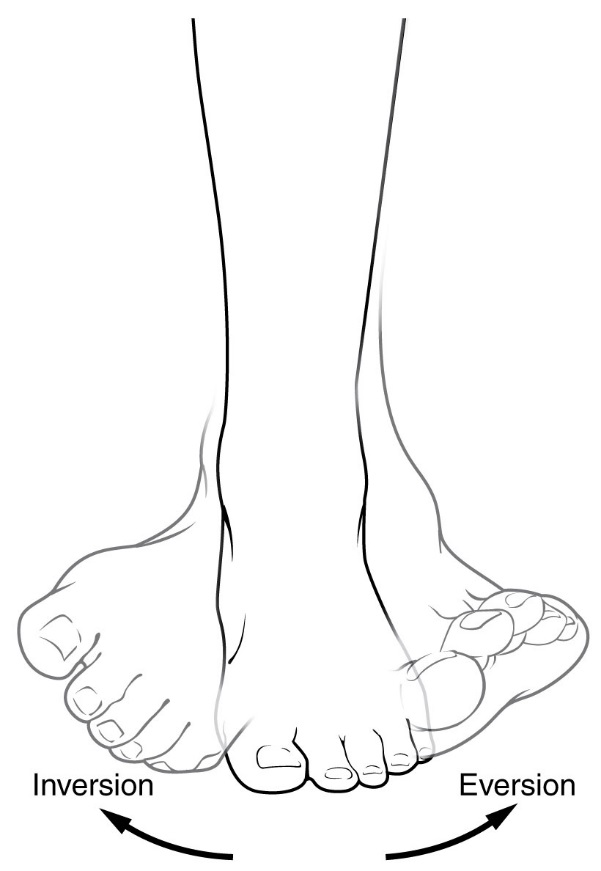
- Everting the Feet
- Ankle Flex (Anterior Tibialis Contraction)
- Introduction to Carving
- Leg Retraction Carving
- Moguls/Bumps (Compression Turns)
Adductor Muscles – One Legged Pivot
Although skiing on one leg (both directions) was covered in yesterday’s blog post today’s intention was to bring focus onto the fact that regardless of which direction the skier is turning there always has to be a strong contraction of the adductor muscle on the leg. This should make the skier realise that when skiing on two skis then the adductors in both legs should be active all the time. The subject was raised to address Mae’s tendency to let go the adductor of the inside leg in the turn and consequently push that inside knee into the turn – which is dangerous (despite being taught in several major nations) Later on when carving Mae was working her adductors correctly as seen in the video. (She also pivoted well during this exercise)
Feet Eversion and Ankle Flex are highly counter intuitive actions but here they are being used to strengthen Mae’s stance which has developed issues due to boots not allowing her to easily stand up straight and cultivating the tendency to collapse at the ankles. This causes the upper body to stay vertical to compensate and then this affects dynamics – causing “catching edges” and a frequent “jet forward” of the skis.
Everting the Feet
When the skis are parallel the feet still “diverge” (as if skating) inside the ski boot – each foot being turned outward (everted). This obviously isn’t visible. This is to combat the tendency to twist the foot inwards to”turn” the ski directly -a mistake which flattens the ski and causes loss of grip.
Ankle Flex (Anterior Tibialis Contraction)
One way to increase pressure on the ski fronts is to flex the ankle inside the ski boot – not by squashing the ankle but by lifting the forefoot toward the shin and creating shin pressure on the cuffs of the ski boots. The boots then act as a lever transmitting force to the ski fronts. Gripping on ice requires pressure on the ski fronts and is strongly aided by the (upward) flexed ankle. Turning power comes mainly from the ski fronts – pressure on the tails of a ski makes it travel straight ahead.
Contracting the shin muscle protects the knee joints.
Keeping the ankle flexed (upwards) protects the knee and helps keep pressure on the front of the ski boot – even while extending the leg.
Extending the (flexed) uphill leg in a turn transition/initiation also serves to protect the knee joint from excessive strain through the quadriceps as the turn progresses.
Introduction to Carving
- while standing still reach one leg out to the side with the ski on edge and then pull it inwards scraping the ground
- now do the same while sliding forward and maintaining some pressure on the extended ski (on gentle and wide terrain)
- the ski will carve an arc with no skidding
- as speed increases the other leg – acting as a stabiliser – can be gradually drawn closer to the extended leg by actively using the adductor muscles
- the main principal exploited here is the direct tension of “pulling” – relating to the analogy of spinning a ball on a string above your head – the only force on the ball is the string pulling inward. Here our centre of mass becomes the anchor pulling the “string”. However – with a bit more speed the “centripetal” force towards the centre comes entirely from the carving ski pushing you inwards.
- the upper body is held over the inside ski – with the belly button centred over the ski and facing the ski tip. Looking down you should see the inside ski midway between your arms.
Leg Retraction – Carving
“Leg retraction” – the extended downhill leg at the end of a turn is retracted to allow the body to cross over the skis into the next turn the fastest way possible – then the new outside leg extends (independent leg action). The video below shows a top World Cup racer using this movement pattern. It’s easier to learn this pattern first and apply it to “normal” skiing before learning how to retract both legs simultaneously with the feet together to absorb bumps.
Moguls/Bumps (Compression Turns)
Here’s a useful video showing proper compression turns at an advanced level. (Warning! – The drills used to “teach” in the clip are mainly inappropriate and fail to show the pivoting nature of bump skiing. However the advanced dynamics used by the demonstrators are correct.)
Competition bumps skiers have their feet close together and many people swear by a “two footed” platform off-piste. This works because both skis pivot always on their uphill edge. The feet are always kept downhill of the body and so are the knees. Using the adductor muscles of both legs pulls the skis together and strengthens the stance. It’s important however to always orient the body on only one hip – preferably the outside one. The hip is the biggest joint in the body and it is very close to the centre of mass. Any confusion around this area leads to confusion everywhere. Motion starts from the centre of mass – so use your outside hip in the turn – pulling it backwards during the turn – to get your reflexes working and your core muscles protecting your back the most efficiently possible.
For bumps the two ski pivot prevents the feet from diverging off in different directions – and it gives two edges for controlling speed in what is after-all a braking form of turning. The overall stance is similar to off-piste but is part of a “compression turn” which has it’s own page here for reference (or soon will have). Avoid resorting to pushing out the heels – it’s always a pulling inwards that’s required.