Body Management (Hip Angulation, Anticipation, Control of Rotation, Linked Short Turns)
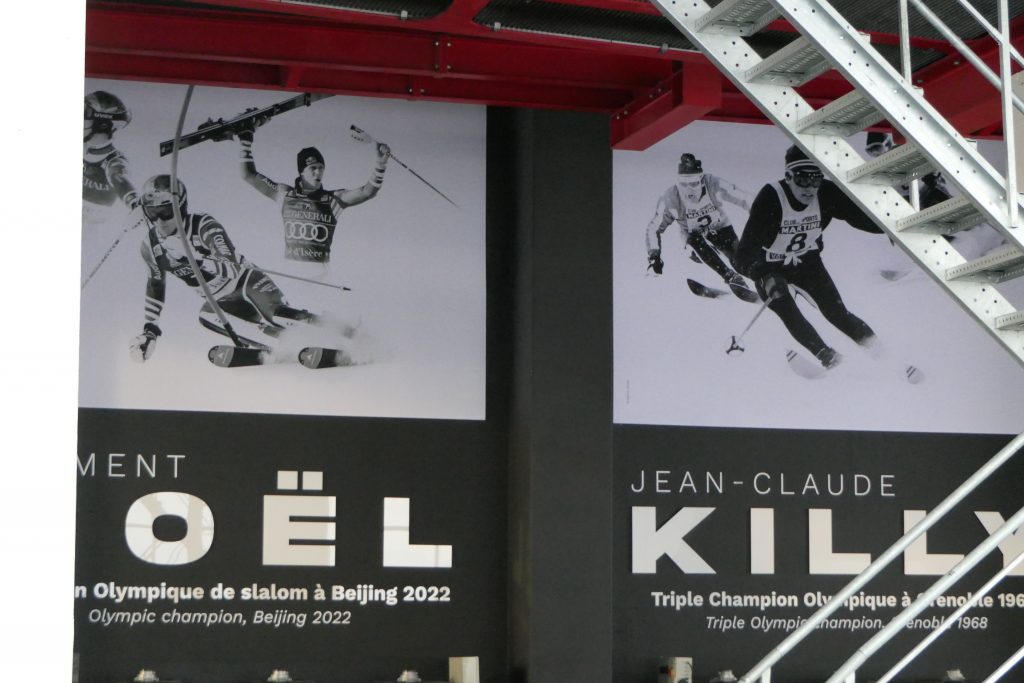
Take a look at the two Olympic champion skiers in the photograph below.
Killy’s image from the 1960s has his chest facing downhill whereas Noel’s image from 2022 has his chest facing forward. What Killy is doing destroys your lower back and is probably why he never went on skis again after he stopped racing.
Protecting the Spine
- Hold the front of the pelvis up – aiming for “neutral pelvis”
- During the turn pull the outer hip backwards so that the ski doesn’t pull it in front of your ribs
- Look for a stretch between the ribs and hip joint
- Look for a reflex contraction of the lower abdominals – the postural reflex
- Keep the shoulders/chest following the skis (to some degree)
- Always “counter turn” the pelvis more than the chest/shoulders (It’s only the pelvis that should “face downhill”)
- Pulling the hip backwards also prevents both hip rotation and full upper body rotation
Source of Hip Angulation
The upper body needs to tilt forward over one hip joint – then rotate around it. This is in addition to pulling back the outside hip etc.
The body shape produced alters the location of the centre of mass enabling pressure on the ski fronts and also greater agility both into and out of turns – and pole planting if the skis are swinging laterally.
The hip angulation also provides flexion of the hip joint that gives absorption of shocks. Increased angulation also increases the edge angle of the skis to the snow and may alter the turn radius and grip.
Angulation when upright and pivoting has another function – when ANTICIPATING the next turn it is used to get the Centre of Mass out of the existing turn (by tilting the torso forward at the hip ) and letting the Centre of Mass move over the skis to plant the ski pole downhill for a strong, clear and definite support.
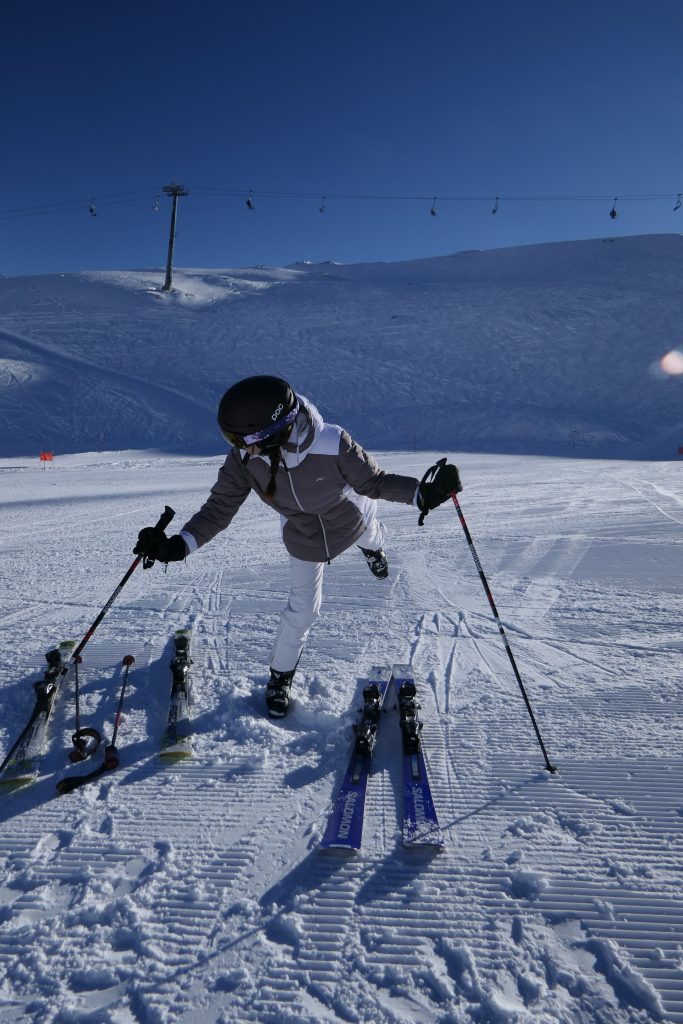
When the entire body inclines into the turn with hip angulation present this below is what it looks like.
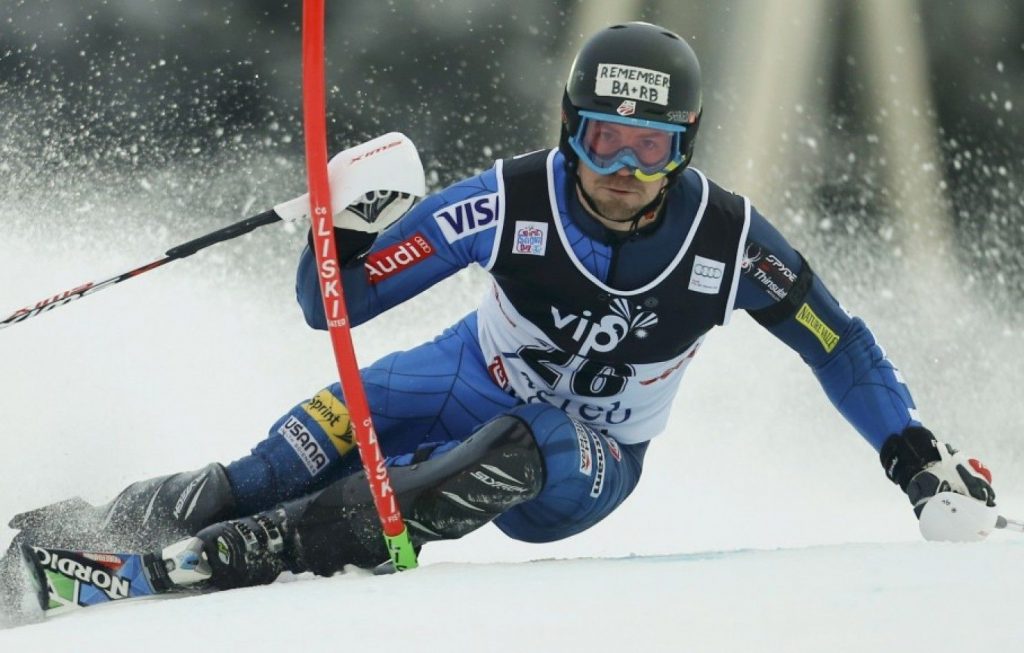
Dynamics 4 (Advanced Angulation)
Creating “angulation” is exactly like dropping one cheek of your bottom onto a chair placed at the side of your body. This gives the impression of “facing downhill” in shorter turns – which is actually an effect not a cause or intention. The action is centred on a relaxation of the hip joint (outside leg) and a falling into the turn particularly in the second half of the turn . The turn initiation (short to medium radius) is with the skier’s pelvis (not necessarily the chest) facing downhill – thrusting the upper body directly downhill while the skis travel across the hill.
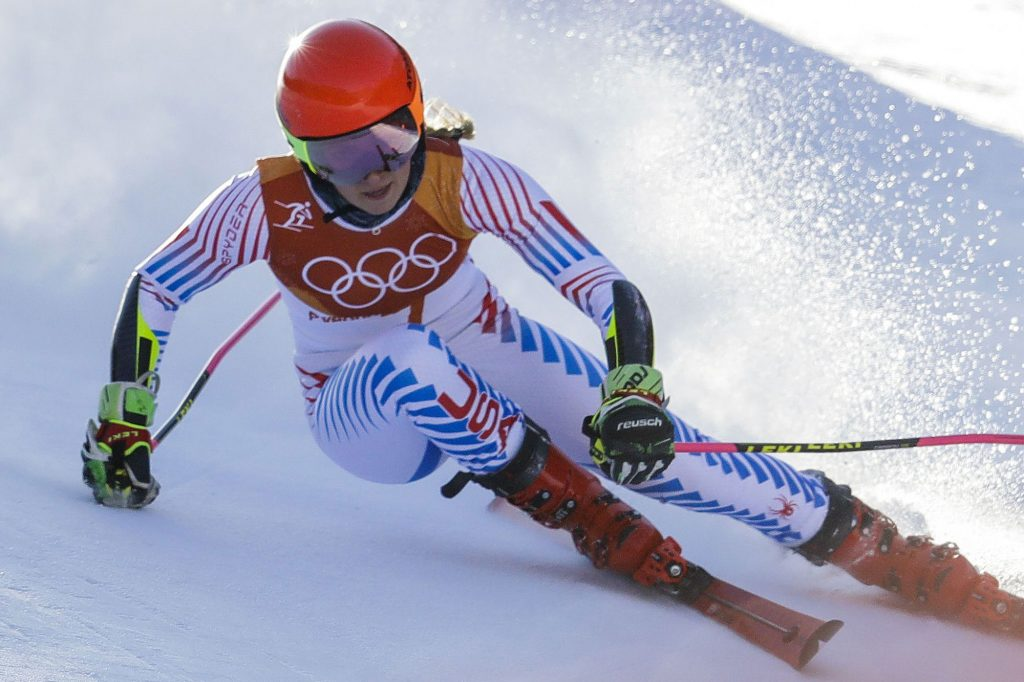
Combining Dynamics and Pivot
- Dynamics depends of forward motion of the skis and lateral falling/pushing of the centre of mass
- Pivot depends on lateral motion of the skis – but always with the centre of mass being driven inward (toward the turn centre) modulated by the support of a pole plant
- The two can be combined – when there is both forward and lateral motion – making overall control of trajectory and speed totally under control of the skier
- In all cases there must be active adductor muscle use – and the feet must be “everted” i.e. turned outward inside the ski boots – diverging sightly (skating stance)
- The essential element to take from combining pivot and dynamics is to execute the turn transition from the uphill edge of the uphill ski – noting that the ski enters the new turn more easily than when on its inside edge and this also prevents stemming (and body rotation)
- Additionally with the transition between the two turns being made from the uphill edge it’s easy to switch into a very tight pivot when desired
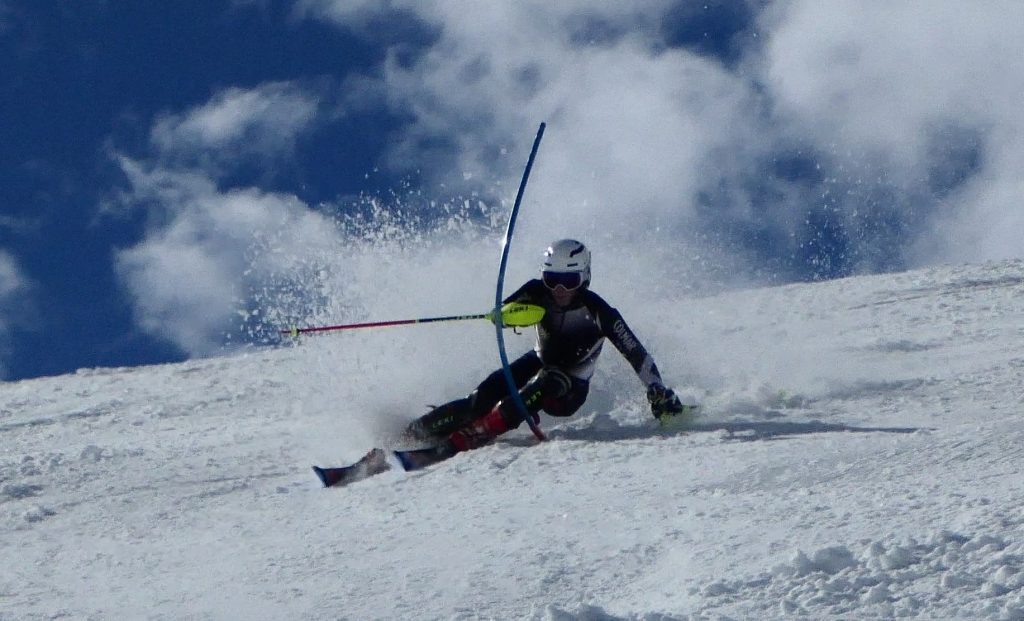
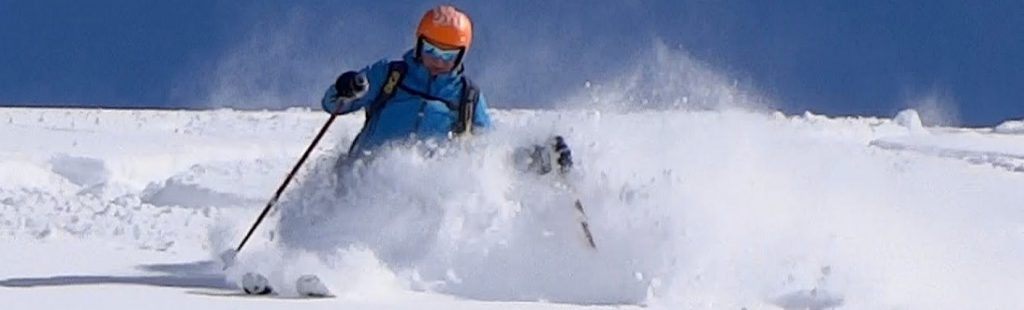
Look at the skis in the two images below. The top image is with skis carving – the bottom image skis pivoting
Pressuring the Fronts of the Skis
When a car travelling forward makes a sudden turn there is an increase in pressure on the front tyres due to them being responsible for deflecting the vehicle in the new direction. In skiing the front of the ski plays the main role in deflecting (turning) the skier but this doesn’t just happen automatically because people tend to defensively avoid pressure on the ski fronts due to fear of falling forward.
Normally people when walking maintain their bodies more or less vertical with respect to gravity and that would be appropriate in skiing for traversing across a slope – but as the skier has to turn downhill they are faced with having to adjust the stance out of the vertical and to be generally perpendicular to the slope. Doing so requires both skill and confidence – which can be undermined by a defensive emotional response. (The root of the word emotion is motere, the latin verb “to move”, with the prefix “e-” meaning “move away”.) The result is the skier tends to remain vertical when pointing down the slope and that puts pressure on the tails of the skis (often through leaning on the backs of the ski boots). When pressure is applied to the tails of the skis they will tend to run straight and not turn.
Racing type turns with free falling dynamics (Centre of Mass (CoM) falling or pushed into the turn) can require an aggressive overall body (CoM) movement forward/downhill into a new turn. Pivoted (braking) turns where the skier remains predominantly on the uphill edges and uses a downhill pole plant for support allows the body to remain more vertical due to the mechanics of the skis working with a lateral swing into the turn. However pressure on the ski fronts remains necessary even for effective pivoting. When pivoting it’s sometimes necessary (as with mogul/bump skiing) to push the tips of the skis downhill with the balls of the feet. (Aggressive mogul skiing requires knees and hips actively bending often more than 90°)
Pressure on the ski fronts is made safe through the use of hip angulation – which brings the centre of mass well to the inside of the turn and allows absorption of bumps etc. Angulation protects the skier from the risk of a face plant over the fronts of the skis – including when skiing in deep snow. Another way to increase pressure on the ski fronts is to flex the ankle inside the ski boot – not by squashing the ankle but by lifting the forefoot toward the shin (still keeping pressure on the balls of the feet) and creating shin pressure on the cuffs of the ski boots. The boots then act as a lever transmitting force to the ski fronts. Gripping on ice requires pressure on the ski fronts and is strongly aided by the flexed ankle.
One exercise to get people to feel the correct pressure on the shins inside their ski boots is to ski downhill backwards.