Short Swings / Jump Turns / Swing Weight
If a jump is made while solidly planting the ski pole then there is zero resistance on the skis so they can literally pivot in mid air – swinging the ski fronts into a turn. Coordination for this is tricky initially and usually work has to be done even on jumping correctly. Most people retract their heels when jumping but they should fully extend their leg in mid air to raise the centre of mass and then flex on landing to absorb the impact smoothly. The soft landing helps to generate a smooth pivot. It’s only necessary to swing the skis a few degrees in the air and then land on the uphill edges to continue a smooth pivot. The pressure cycle and dynamics of coming down into the turn from landing also help to drive the pivot once it has been initiated. When turns like this are linked with a rebounding effect and fluent rhythm they are called short swings. Most people at the start are unable to keep their body from rotating or pushing out the heels/ski tails so they are often unable to use their ski poles properly and unable to keep a good rhythm or accurate coordination.
Off Piste Technique
- Freeride
- Fall Line
- Traversing and Kick Turn
Freeride
The modern trend is toward using very wide skis and actually skiing with little difference from carving on the piste – long turns and high speed. The wide skis give good flotation. Hidden rocks are always a concern and there’s a lot of risk involved. The drawback with such wide skis is that they are difficult to hold on edge on hard snow or ice when the ski width underfoot exceeds 10 cm. Personally I find “flotation” uninteresting (not being an adrenaline junkie) and that there’s more fun when your skis can sink deeper into the snow and provide a rebound and generate many more turns.
Fall line
There are many different kinds of snow condition that require adaptation to ski but for the moment we will look at predominately pivoting on two skis – which implies fresh, light snow and moderate depth. For off-piste pivoting a seated stance is often needed in deep snow. This works because you are not skiing across the hill, you are skiing in the fall-line – so your bottom is “sitting” uphill. Imagine sitting on a chair on a slope, when facing downhill you would not have your weight falling backwards – it would even be hard to remain on the chair and all the forces would pass through the feet. This works even better with speed. The knees and feet being ahead of the body allow unseen obstacles to be absorbed. People tend to “lean back” when skiing off-piste to try to achieve a similar effect but that only locks up the leg muscles and tires them out.
Just angulating and facing your bottom uphill – plus pulling the outside hip backwards (ChiSkiing) – when combined with inclination into the existing turn – can substitute for the seated stance and even permit the fronts of the skis to be used more strongly off piste – with relatively straight legs and without the threat of being pitched over the fronts.
If the slope is steep enough to get moving properly and the snow is not wind packed then it’s best to keep the feet together and use both skis as a single platform. This usually leads to a natural rhythm and resonance with the skis loading up then rebounding – making pivoting much easier as your skis rebound towards the surface of the snow.
Dynamics is in fact the master key to always nailing your off-piste turn.
If in doubt revert to big Turn Exit Dynamics. When snow is of good quality and offering no serious resistance then pivoting is ideal. Obviously there is a crossover here where various degrees of blending between dynamics and pivoting are possible – depending on snow quality. The worse the snow the more dynamics are obliged.
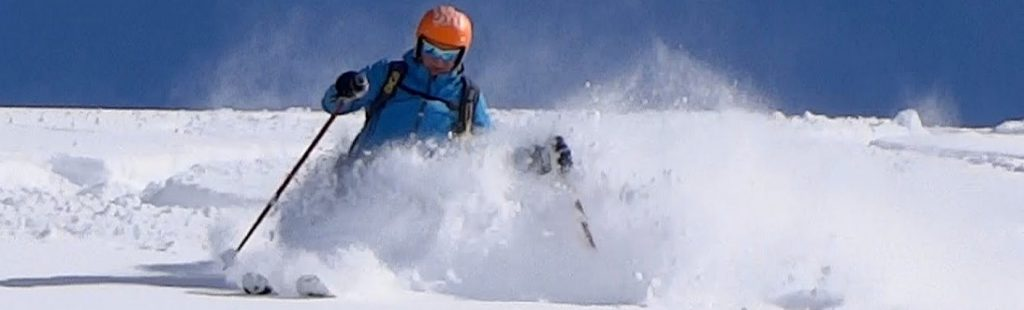
If the skis can pivot in the snow then as with linked pivots on the piste the pole plant helps the body direct and control the centre of mass. Looking downhill at the pole plant the centre of mass is projected almost diagonally backwards downhill as it crosses over the skis which are still travelling across the slope on their uphill edges.
If the skis can’t be assured to get the skis to pivot then it’s important to stay on the outside, downhill ski and combine the crossing of the centre of mass downhill over the ski with an extension of the downhill leg to generate a lifting up exit from the turn (Turn Exit Dynamics) – then guaranteeing a change of edges to initiate the next turn.
In all circumstances it’s the motion of the centre of mass that has to be active.
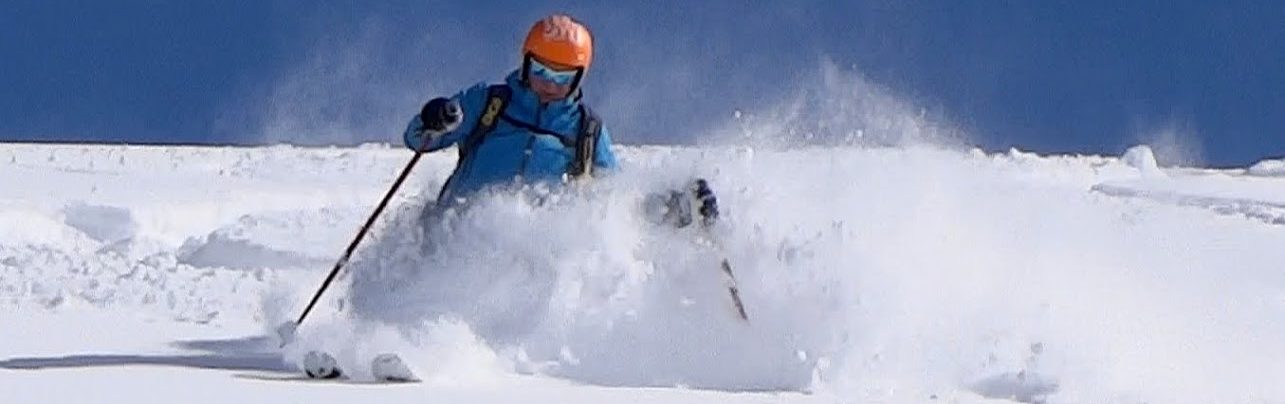
In the top photo below the skis are kept flat for pivoting and the ski pole is planted to guide the centre of mass.
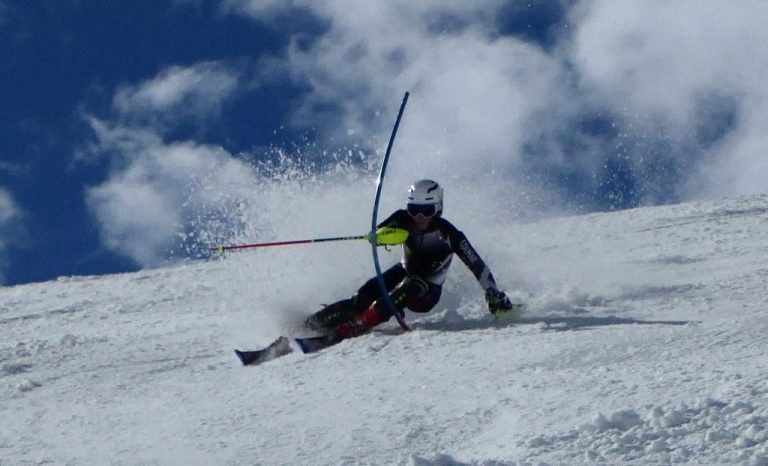
In the photo below there is no pivoting – just dynamics – so the skis are placed on their edges.
Line – Turn Apex
When snow conditions are difficult it becomes important to use a racing timing where the apex of the turns is out to the sides and not directly downhill of the skier. This prevents an overload of the skis when resistance against gravity is at its greatest at the end of the turns.
Traversing and Kick Turn
When nothing seems to work or there is physical exhaustion then just traverse to lose height and execute a static kick turn at the end of the traverse and continue with this until the bottom of the slope.
Ankle Flex (Anterior Tibialis Contraction)
One way to increase pressure on the ski fronts is to flex the ankle inside the ski boot – not by squashing the ankle but by lifting the forefoot toward the shin and creating shin pressure on the cuffs of the ski boots. The boots then act as a lever transmitting force to the ski fronts. Gripping on ice requires pressure on the ski fronts and is strongly aided by the (upward) flexed ankle. Turning power comes mainly from the ski fronts – pressure on the tails of a ski makes it travel straight ahead.
Contracting the shin muscle protects the knee joints.
Keeping the ankle flexed (upwards) protects the knee and helps keep pressure on the front of the ski boot – even while extending the leg.
Extending the (flexed) uphill leg in a turn transition/initiation also serves to protect the knee joint from excessive strain through the quadriceps as the turn progresses.
Introduction to Carving
- while standing still reach one leg out to the side with the ski on edge and then pull it inwards scraping the ground
- now do the same while sliding forward and maintaining some pressure on the extended ski (on gentle and wide terrain)
- the ski will carve an arc with no skidding
- as speed increases the other leg – acting as a stabiliser – can be gradually drawn closer to the extended leg by actively using the adductor muscles
- the main principal exploited here is the direct tension of “pulling” – relating to the analogy of spinning a ball on a string above your head – the only force on the ball is the string pulling inward. Here our centre of mass becomes the anchor pulling the “string”. However – with a bit more speed the “centripetal” force towards the centre comes entirely from the carving ski pushing you inwards.
- the upper body is held over the inside ski – with the belly button centred over the ski and facing the ski tip. Looking down you should see the inside ski midway between your arms.